I used to leave process workshops with a notebook full of half-sentences, arrows that only I understood, and a promise to "clean it up later." Later often meant redrawing the whole thing from memory. Somebody would look at version one and say, quietly, that a step was missing. Or that two teams never hand off that way. Or that the exception path is the path everyone actually uses.
AI does not fix the politics of process work. It can shrink the time between messy notes and a first draft map people can argue with. That is useful. A blank page is hard to correct. A draft map that is mostly right tends to pull the real process out of people faster.
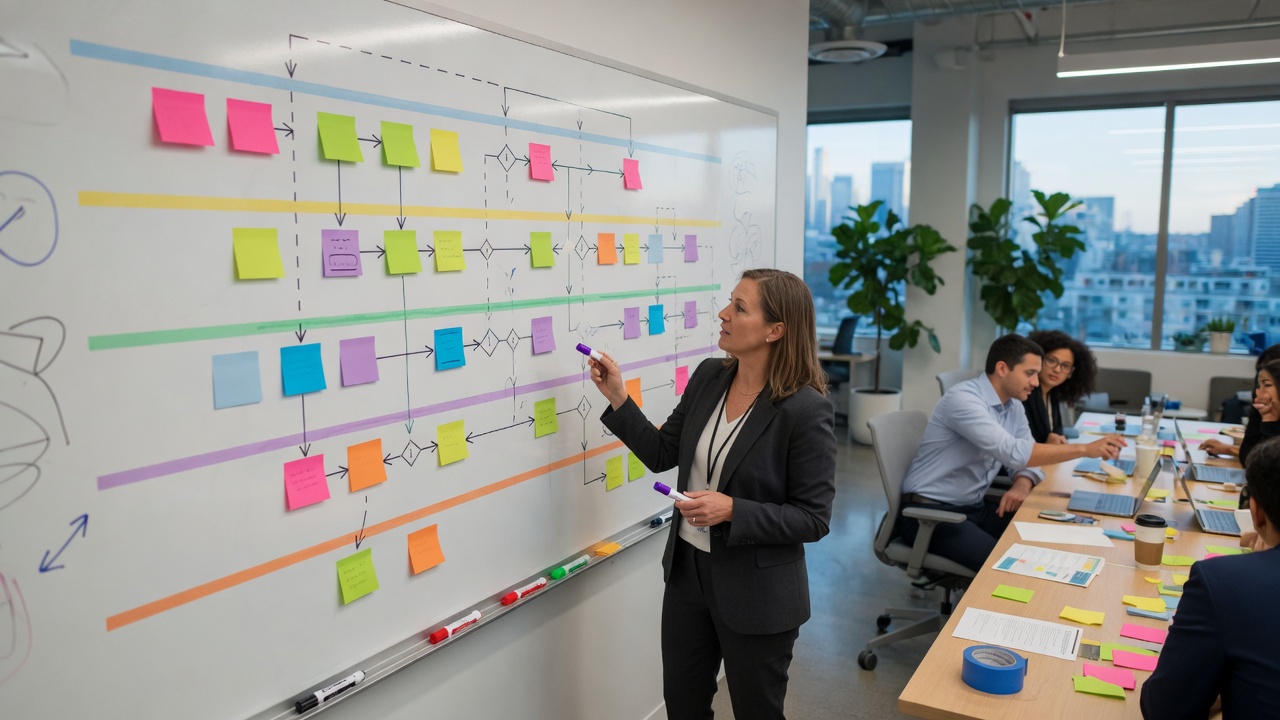
A swimlane map is a process diagram split by who does the work. Each lane is a role, team, or system. Steps sit in the lane of the actor who owns them. Handoffs show up as the flow crossing lanes. If you have never drawn one, think of a relay race drawn as boxes: who has the baton, when they pass it, and where it stalls.
Those diagrams matter because so much waste hides in handoffs, not in the individual tasks. Mapping by lane makes the wait between teams visible. It also forces a conversation about ownership that a pure flowchart sometimes skips.
I do not ask a model to invent a process from a one-line prompt. That is how you get plausible fiction. The working pattern looks more like this:
The last step is the one that matters. Without it, you publish a diagram that sounds right in a board pack and fails on the floor.
Helpful asks tend to be concrete. "From these notes only, list steps in order, name the role for each step, and list any decision as a yes/no or branch. Mark any step not supported by the notes as [ASSUMED]." That kind of constraint reduces invention.
Less helpful: "Create a best practice process for claims handling." Best practice according to whom? The model will produce something generic. Your operation is rarely generic. Volume, systems, regulation, and tribal knowledge change the shape of the work.
I also ask for a short "evidence map": which paragraph or bullet supports each step. When the model cannot point to a source, that step gets challenged first in the validation session.
They smooth over exceptions. Real processes are full of rework loops, "call so-and-so," and unofficial shortcuts. Models like clean linear stories. Push for rework paths and exception paths on purpose.
They invent systems. A CRM, a portal, a "workflow tool" appear because those words are common in training data. If your notes never named the tool, do not put it in the map until someone confirms it.
They undercount wait time. The map shows activity boxes. The pain is often the three days between boxes. When you validate, ask: where does work sit? Who notices? What triggers the next person?
And they merge roles. "Operations" is not a lane if three different desks own three different steps. Split lanes until a real person can say "that is my step."
I like a 45-minute validation: print or project the draft, walk the happy path once, then chase the three most common exceptions. Someone owns a marker for "wrong," someone owns "missing," someone owns "rare but dangerous." End with a short list of open questions, not a perfect diagram.
Version the map. Draft from notes is v0. After validation, v1. After a pilot or time study, v2. AI accelerates v0. People own the rest.
Because the first draft used to take a long evening, and that delay often meant the workshop energy cooled off. Getting a map in front of people while the conversation is still warm can change the quality of the corrections. You might still redraw half of it. That is fine. Redrawing from a shared object is different from starting from nothing.
If you already facilitate process sessions, you are not learning a new job so much as getting a faster sketchpad. Keep judgment where it belongs: with the people who do the work, and with the facilitator who knows when a nice diagram is lying.
I help teams turn discovery notes into process maps people can trust, with AI as a drafting aid rather than the source of truth. That often includes:
Reach out for a quick chat on how I can help at Suganth@AruviConsultancyServices.com