I have been excited about vibe coding for a while. Also a bit uneasy about it.
On one hand, I have used it to spin up real things fast. An MVP for a client in under a week. A full site with UI, payments, authentication, and deployment when I am not a developer in any serious sense. That still feels slightly unreal. On the other hand, every time people talk about shipping “the first draft” straight into production, I think about security reviews, dependency risk, access control, and the quiet ways messy code fails under load.
At this stage, for most enterprise work, vibe coding has not felt like a final draft. It has felt like a powerful first draft that still needs multiple hardening passes, extra prompts, and real human judgment. That is fine for demos. It is not fine for customer data and regulated systems if you stop too early.
Even with those limits, the value is obvious. Use it to demonstrate intention. Show the client the shape of the software. Confirm the use case is real before you burn months on build plans.
That alone can save weeks. Sometimes more. You walk into a meeting with something people can click, not only a deck. Stakeholders argue about the product instead of imagining it from slides. For an AI workflow or internal tool conversation, that shift matters.
I have treated that as the honest boundary: great for MVP and discovery, incomplete for enterprise production unless you add a lot of process around it.
In early August 2026, Superblocks and AWS announced a multi-year strategic collaboration centered on Superblocks 3.0. Press materials were dated around late July. This is a deep partnership and product integration, not an equity investment from AWS.
Superblocks positions itself as an enterprise “vibe coding” platform. The collaboration tightens AWS as its preferred cloud, with joint go-to-market, co-marketing, field enablement, and workshops. AWS treating this as strategically important (not only a Marketplace listing) is the part that caught my attention.
The bottom line of the announcement is simple enough: major cloud providers are actively backing platforms that keep data and inference inside the customer’s private cloud, rather than shipping everything to external consumer AI tools.
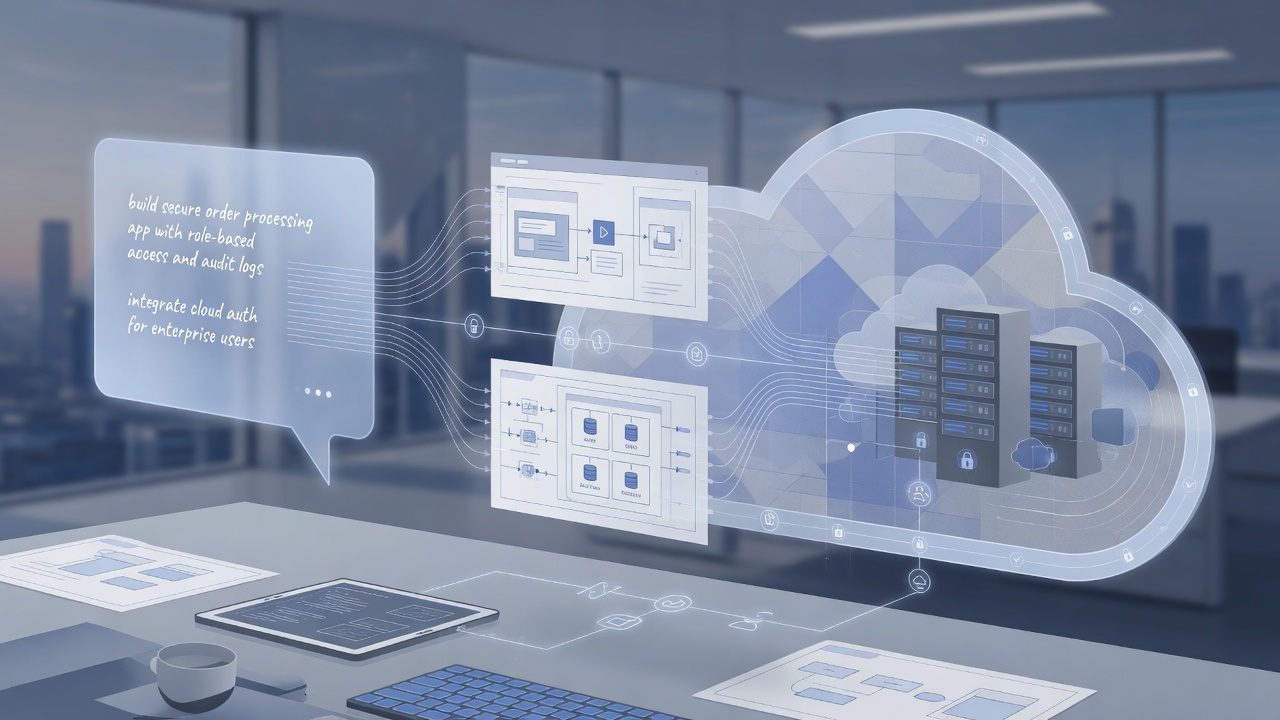
The core story is business users generating production internal applications from natural-language prompts, while keeping the work inside the customer’s own AWS environment.
The capability they emphasize is Cloud-Prem deployment:
There is also a Smart Router on Bedrock that claims to route simple tasks to cheaper or open-source models and complex ones to frontier models, with up to about 30% lower token costs. I treat vendor cost claims carefully, but the architecture idea is sensible: not every prompt needs the most expensive model.
They also highlight a swarm of security agents that scan and fix vulnerabilities, policy agents that enforce company standards before production, and the ability to import prototypes from consumer tools while moving them into a governed environment. That last piece is practical. People will keep prototyping in Replit, Lovable, Claude desktop, and similar tools. The question is whether those prototypes ever land somewhere IT can live with.
Consumer vibe-coding tools create real enterprise risks. Untracked customer data in random accounts. Public exposure of prototypes. Malicious packages. Pure shadow IT. I have watched the pattern before with no-code tools and “temporary” SaaS trials that somehow became production.
Superblocks plus AWS is positioning itself as the governed alternative: business teams get speed, while IT and security retain control, auditability, and data residency. Customers can buy through AWS Marketplace so spend can draw down existing AWS commitments and earn credits. That matters to procurement more than most technical people admit.
Company context, for what it is worth: Superblocks has raised about $60M (Series A in May 2025) from investors including Spark Capital, Kleiner Perkins, Meritech Capital, and Greenoaks. It is still a relatively small team (around 50 people) already used by companies such as Instacart and Benchling, banks, and at least one financial services firm (Flex) that has deployed dozens of apps across departments. Small team, real logos. That combination is either impressive or a scale risk, depending on your risk appetite.
Partly.
I still do not believe “type a prompt, ship to production, walk away” is responsible enterprise software. Security hardening, review, testing, ownership, and operating models still matter. Agentic AI does not remove judgment. It moves where judgment has to sit.
What changed is the ceiling. If platforms can run the full AI coding loop inside a customer’s AWS account, with single-tenant isolation, IAM, security agents, and policy checks before production, then vibe coding stops being only a consultant’s demo trick. It starts looking like a governed AI workflow for internal applications. That is a different category from “someone on the business team used a public AI coding site and emailed a zip file.”
For AI consulting work, this is useful. It means conversations with security and architecture teams can move from “please ban the tools” toward “how do we provide a controlled lane that is faster than the old backlog?” That is often the real fight: not whether AI can draft UI, but whether the organization has a safe place for that speed.
If a client asked me tomorrow whether they should “do enterprise vibe coding,” I would not start with a platform pitch. I would start with use cases.
Then I would ask about boundaries: where does data live, who approves production, how are secrets handled, what gets reviewed, what is the rollback plan. The Superblocks and AWS story is interesting because it maps to those questions more honestly than consumer tools do.
I would also keep the older lesson. Speed without a second pass on security is still a liability. Multiple prompts to harden auth, access, logging, and dependency risk are not a failure of vibe coding. They are part of treating it like software.
Vibe coding already saves time as a way to show intention and test whether a use case is worth building. That part has been real for a while.
What feels newer is the push from major clouds to make a governed version of that workflow legitimate inside the enterprise security boundary. Superblocks 3.0 on AWS is one of the clearer public signals of that shift. Official AWS press materials and TechCrunch coverage around August 3, 2026 are the primary sources for the partnership details above.
I am not saying every bank should hand production systems to a prompt tomorrow. I am saying the days of dismissing enterprise vibe coding as only a toy are getting shorter. The interesting work now is designing AI workflows where speed and control show up in the same sentence.
I help organizations move from AI demos to delivery patterns that security and operations can live with. That often includes:
If your teams are already prototyping in consumer tools and IT is nervous for good reasons, we can map a safer path that still keeps the speed.
Reach out for a quick chat on how I can help at Suganth@AruviConsultancyServices.com