Someone always wants the SOPs updated by Friday. The people who know the work are busy doing the work. The old procedure PDF still says "email the form to the shared mailbox" three system replacements later. So the gap grows, and training becomes tribal knowledge plus a few screenshots in a chat thread.
AI is good at first drafts. That is both the opportunity and the risk. A fluent procedure that is wrong is more dangerous than a missing one, because people may follow it. The question is not "can AI write SOPs?" It can. The question is how you keep accuracy, version control, and sign-off honest.
An SOP (standard operating procedure) is a controlled description of how a process should be performed: purpose, scope, roles, steps, inputs, outputs, exceptions, and references. It is not a brainstorm. It is not a blog post. In regulated environments it can be part of how you prove control. Even outside regulation, a good SOP reduces onboarding time and argument about "how we do this here."
I treat the model as a junior writer who has never set foot in your office. Feed it grounded material: interview notes, the current (even outdated) SOP, screenshots with sensitive data removed, decision rules, and a process map if you have one. Ask for a draft in your template structure. Require a section called "Open questions and assumptions" at the end so invented polish does not hide gaps.
Then redline against practice. Sit with one or two practitioners and walk each step. Mark what is true, what is aspirational, and what is pure fiction. Aspirational steps are fine if you label them as target state. Mixing as-is and to-be in one document without labels is how teams get confused during training.
Only after that does the draft enter formal review. AI does not get a signature block.
I also ask the model to generate a short quiz or checklist from the draft. If practitioners cannot answer the quiz from real work, the SOP is wrong or incomplete. That test is cheap and surprisingly effective.
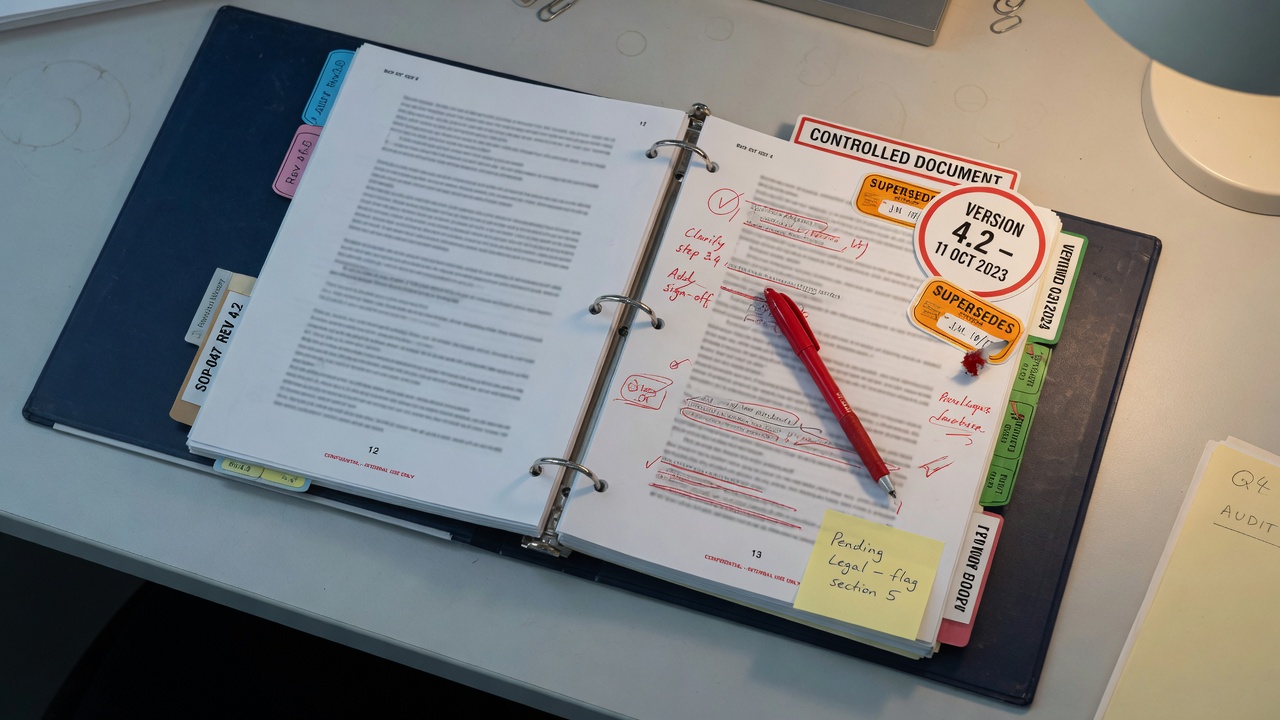
Store SOPs where version history is real: a document management system, a wiki with page history, or a Git-backed Markdown set if that fits your culture. Each version needs an ID, effective date, author, reviewer, and what changed in plain language.
Do not let chat history become the master file. People will re-prompt, get a slightly different procedure, and train from whichever PDF they downloaded last. One controlled source. Drafts can live elsewhere. Published truth lives in one place.
When you use AI for a revision, log that in the change note: "Draft assisted by AI from workshop notes dated …; reviewed by …" Transparency helps later when someone asks why a step appeared.
Sign-off should map to real accountability:
AI is none of those roles. If a tool auto-publishes without a human gate, you have an uncontrolled document generator, not a procedure system.
A procedure without a map can hide handoffs. A map without a procedure can hide the detail people need at the desk. I often draft both: a swimlane for the flow, an SOP for the step instructions. The free Process Map Studio is enough for many workshops. Keep map and SOP version numbers in sync when you can, or at least reference each other.
You will not get perfect documentation for every micro-task on day one. Aim for the processes that are high volume, high risk, or high training load. Use AI to cut the blank-page cost. Use people to cut the fiction. Use controlled publishing so last month's draft cannot pretend to be today's rule.
If your team is already pasting work into consumer chat tools to "just get a procedure," the answer is usually not a ban alone. Give them an approved path: template, safe tool, review checklist, and a clear owner. Shadow documentation is a symptom of missing process ownership as much as it is a technology problem.
Write the draft fast. Approve it slowly enough to be true. That balance is the whole game.
I help organizations draft and control procedures so documentation matches real work and AI stays in a drafting role. That often includes:
Reach out for a quick chat on how I can help at Suganth@AruviConsultancyServices.com