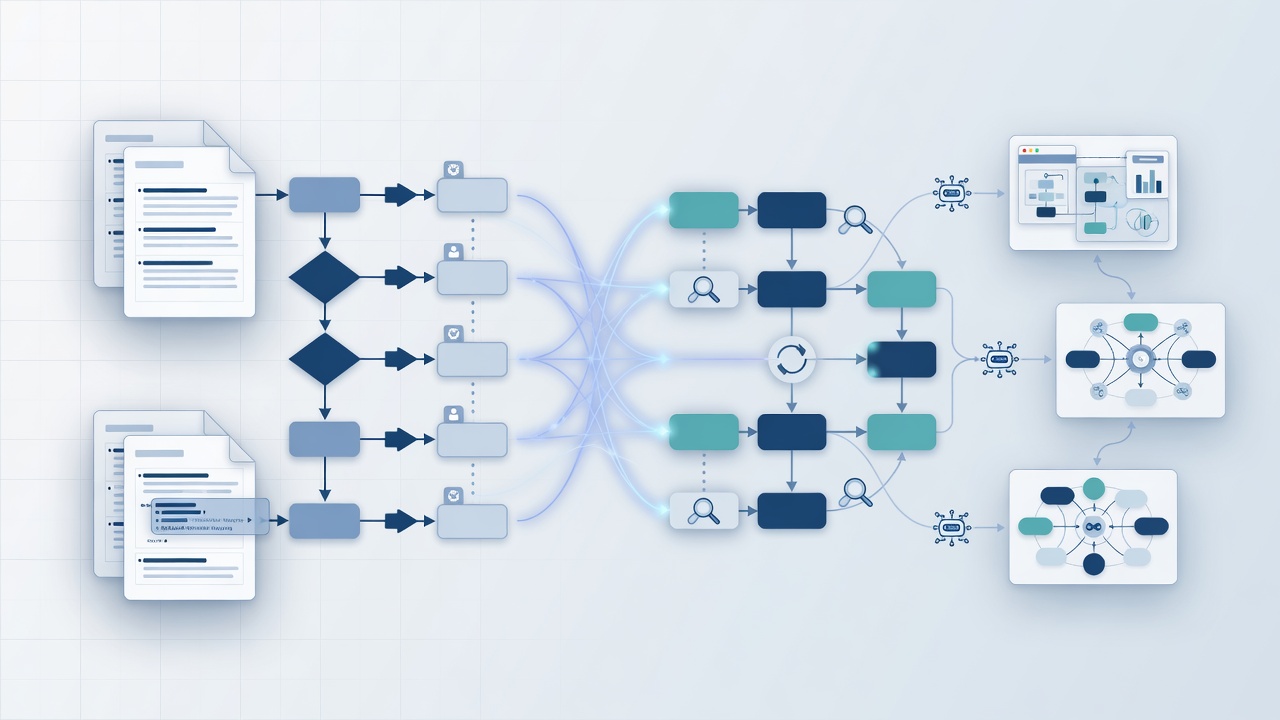
My background as a business analyst, and a lot of time spent on process design, requirements, and use cases, has turned out to be solid ground for working with AI. That can surprise people who still assume AI is only for data scientists and engineers. In practice, the people who understand how work actually gets done are often well placed to design AI solutions that organizations might actually adopt.
If you are a business analyst, process analyst, or operations-focused consultant, this is a moment worth paying attention to. AI does not remove the need for structured thinking about business needs. It tends to make that thinking more valuable.
Business analysts are trained to do something many AI projects need badly: turn ambiguity into structure. Documenting requirements, writing use cases, defining actors, preconditions, exceptions, and success criteria is not leftover paperwork from another era. It is a mental model for systems that have to behave predictably when real people use them.
When I approach an AI product, I still start where good BA work usually starts:
Those questions map cleanly onto AI solution design. A use case can become a workflow. Acceptance criteria can become evaluation checks. Exception paths can become guardrails. Stakeholder needs can become product priorities. Thinking in scenarios is often what keeps AI from turning into a generic demo with no operational fit.
A heavy process background can be a real advantage in AI work. Process analysts understand handoffs, bottlenecks, controls, service levels, and the gap between the official process and what people actually do. That matters because AI creates value when it sits inside work, not when it floats next to work as a disconnected chatbot.
With process fluency, it often becomes easier to spot:
Process-heavy analysts are often well equipped to separate hype from fit. They can turn business needs into workable AI products because they already think in flows, roles, rules, and outcomes.
The path I use is fairly straightforward:
It is BA discipline applied to modern delivery. You often get AI software that is easier to explain, easier to adopt, and easier to govern, because it was designed from the business need outward rather than from the model inward.
As organizations get more serious about AI, many look beyond public chat tools toward local or specialized models. Training, fine-tuning, or adapting local LLMs is not only a technical exercise. It depends heavily on domain knowledge: what language the business uses, what “good answers” look like, which documents are authoritative, and which scenarios matter most. That same discipline is what makes RAG work. Company-specific AI that retrieves the right policies and process knowledge before it answers tends to be far more useful than a generic model alone.
Business analysts are often the people who already hold that knowledge, or know how to pull it out of subject-matter experts. Curating training examples, defining evaluation scenarios, documenting edge cases, and clarifying policy constraints are natural extensions of requirements work. If you can write a strong use case, you can help define a strong evaluation set. If you can map a process, you can help design when a local model should assist, escalate, or refuse.
For larger organizations, AI solutions rarely stop at a single prompt. They often need multi-step workflows: retrieve information, reason, call tools, validate outputs, request approvals, write back to systems, and log decisions. Frameworks such as LangGraph are built for that world. Graph-based, controllable agent workflows where each step can be explicit, testable, and governed.
This is another place where BA and process skills tend to shine. A LangGraph-style solution is essentially a process model made executable:
Analysts who already document process maps and decision tables can often understand and design these systems faster than teams that only think in pure engineering terms. The technology is new. The need for clear workflow design is not.
I would strongly recommend that business analysts and process-heavy professionals pick up practical AI skills. Not necessarily to become full-time model researchers. More to become the translators and builders who connect business reality to AI capability.
High-value skills to develop include:
These skills can make careers more resilient. Organizations need people who can sit between the business and the technology and ship outcomes, not just documents, and not just experiments.
AI is changing how software gets built and how work gets done. The professionals who already understand requirements, processes, stakeholders, and controls are not necessarily behind. They may be standing on one of the better ramps into this work. Pair that foundation with modern AI literacy, and you can design solutions that are both capable and operationally sound.
That is the pairing I rely on: business analysis discipline plus AI delivery. It is how you convert business needs into products people might actually use, from local LLM work to larger workflows with tools like LangGraph.
I help organizations and professionals bridge business analysis discipline with practical AI delivery. That can include:
If you want to put your process and analysis strengths to work in AI, or help your organization do the same, let’s talk.
Reach out for a quick chat on how I can help at Suganth@AruviConsultancyServices.com