Why every organization needs a living company knowledge base
Generic AI can write a decent email and summarize an article. Ask it something only your company would know (your EU refund policy for enterprise customers, your vendor onboarding steps) and it often stalls or invents something plausible. It does not have your material.
That is usually a knowledge problem, not a model problem. Company-specific AI needs a place where the organization’s own information lives and can be looked up. RAG is one practical way to do that.
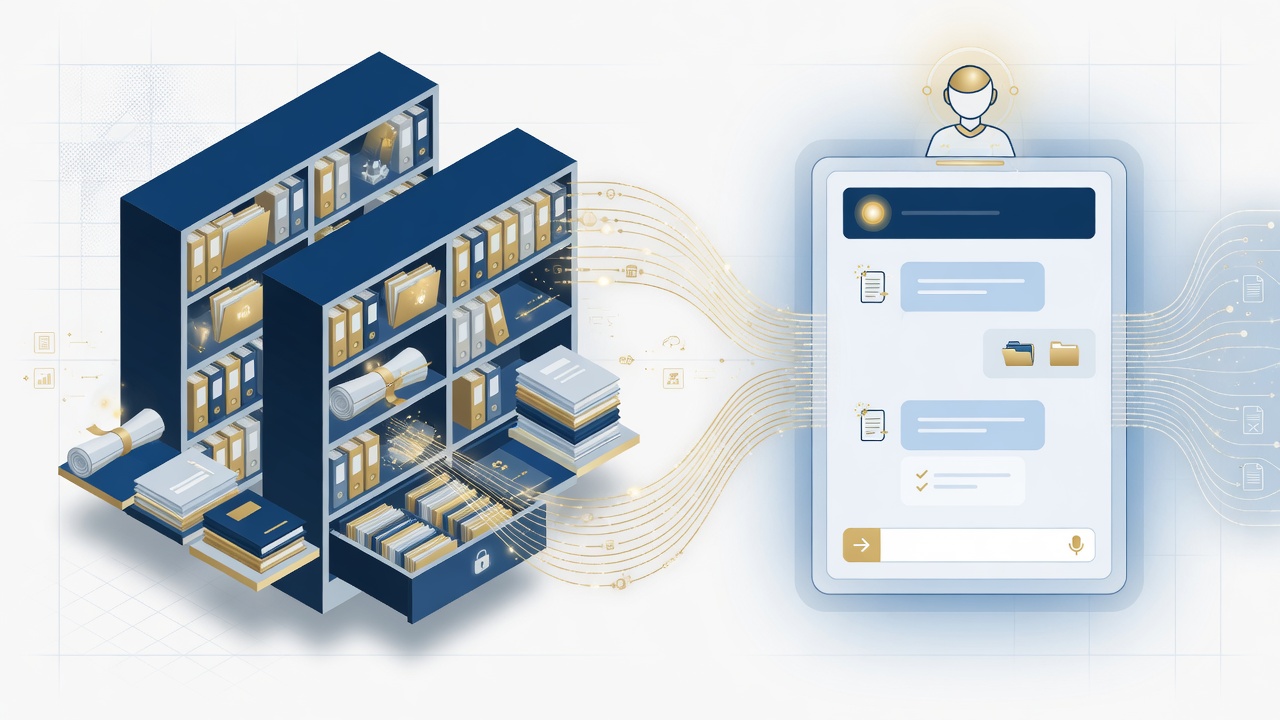
RAG means Retrieval-Augmented Generation. In plain language: before the AI answers or acts, it searches a private knowledge base and pulls the bits that seem most relevant.
Picture a searchable company library. The system finds the right policies, procedures, product notes, contracts, tickets, or guidelines, then writes from those pieces rather than from general training alone. You keep control of the knowledge. The model just gets to use it.
Done well, scattered docs, wikis, tickets, and databases become something AI can draw on when people ask. That fits the same discipline I write about when data ownership must remain in your hands, and when AI projects are treated as data projects.
A general model does not know your products, customers, processes, or culture. It cannot reliably speak to internal policy, current pricing, recent decisions, or proprietary methods. When it has to guess, you get confident wrong answers. That is the hallucination problem people keep running into.
Connecting the model to real company knowledge is how you make it useful for your context. RAG is often the mechanism. Without something like it, you mostly have a clever generalist. With it, the same model can answer from what you actually publish and approve.
This is also why LLMs were a gateway for me, not the whole journey. A strong model still needs retrieval, tools, and control around it. I talk about that in the future of harnessing LLMs: better systems around the model, not only a bigger brain.
Many large organizations already run RAG-style setups for knowledge work. Internal assistants search thousands of documents, policies, and past decisions. Support teams use it so agents and bots stay closer to current product docs and customer history.
One repository can feed several audiences. Legal might check proposed language against approved clauses. Finance looks up the internal reading of a guideline. Product surfaces old research. Ops pulls the right SOP. Different interfaces, same underlying store.
When that base is maintained, you cut down on conflicting answers and endless hunts through shared drives and chat threads. People start working from something closer to a shared institutional memory that AI can actually read.
Smaller firms often assume RAG is only for enterprises with data science teams. That is less true than it used to be. Giving AI access to your own knowledge helps a 20-person shop as much as a global one, even if the stack is simpler.
You can start with what you already have: handbooks, product guides, FAQs, sales playbooks, process notes. Once those form a knowledge base, the same assistant can help with internal questions, customer-facing answers, and light automation. Scale is smaller. The payoff can show up fast: fewer repeat questions, more consistent answers, faster onboarding.
For a lot of SMBs, this is how institutional knowledge leaves a few people’s heads and becomes findable by everyone else (including when someone is out or leaves).
Internal chatbots are a common, high-value use of RAG. Instead of pinging colleagues with the same questions, people ask an assistant grounded in approved policies and docs.
Typical questions look like:
Grounded answers tend to reduce tribal knowledge and inconsistency. New hires ramp a bit faster. Experienced people spend less time re-answering the basics. The knowledge base gets more useful as you add documents and decisions, provided someone actually owns upkeep.
Process clarity helps. When teams map how work really flows (for example with the free Process Map Studio under Free Tools), it is easier to decide which procedures belong in the knowledge base in the first place.
Customer-facing bots gain even more from RAG. People want accurate, current product, pricing, and policy information. A generic model cannot provide that from thin air. An assistant with your approved content can get much closer.
If the knowledge base holds product docs, help articles, warranty terms, shipping policy, and approved messaging, the bot can answer more like a well-trained agent. Policy changes can flow into the base rather than waiting for someone to rewrite a scripted flow by hand. Scripted bots and ungrounded AI both struggle here for different reasons.
For complex products or regulated industries, consistency is not just convenience. It can lower support cost, improve trust, and reduce the chance of wrong information that creates legal or reputational headaches.
RAG is not only for chat. It can sit under automation that needs company-specific rules before it drafts or routes something.
Examples: drafting routine customer replies from official content, routing internal requests per documented procedure, first-pass reports that reference internal material, or checking a proposed step against current policy. Reliability tends to improve when the system retrieves real text instead of relying on general reasoning alone.
When agents also need to act in tickets, files, or CRM, the integration layer starts to matter as much as the model. I cover that in MCP vs AI: why the protocol is starting to matter more than the model.
Over time, use and feedback can improve the knowledge base, and better knowledge can improve the automations. The repository stops being a static archive and starts acting like an operational asset, as long as someone maintains it.
RAG works best when you treat company knowledge as something that changes, not a dump of PDFs from three years ago. Policies shift. Products evolve. Decisions pile up. A maintained base reflects that and makes the current picture available to people and to AI.
Plenty of organizations already have the information they need. It is scattered, hard to find, or locked in a few veterans’ experience. Retrieval turns that into something searchable and usable. Internal assistants, customer bots, and automated workflows can share the same foundation.
Company-specific AI then has a chance to be specific. It can lean on the policies, products, processes, and history that matter to you, with less guesswork and more consistency, if the inputs stay clean and current.
If you care about knowledge, speed, and consistency, generic models alone often fall short. They are a strong starting point. They are incomplete without access to your own information.
RAG is one way to fill that gap: turn internal documents and data into a knowledge base the AI can retrieve from. Large companies already do versions of this. Smaller ones can apply the same idea at a scale that fits their resources. Whether the surface is an internal assistant, a customer chatbot, or an automated process, the requirement is similar: the AI needs to find and apply real company knowledge.
Organizations that treat knowledge as an asset and make it available through retrieval tend to get more durable value from AI. Those that only point a generic model at their problems will keep getting generic answers.
Company-specific AI needs company-specific knowledge. RAG is how a lot of teams make that knowledge usable.
If you want help standing up RAG on your own material (policies, product docs, process notes, support content), I can work with you on that. Typical focus areas:
We can start with one concrete use case, prove it works, then decide whether to widen the scope.
Reach out for a quick chat on how I can help at Suganth@AruviConsultancyServices.com