I still hear leadership teams say "we need an AI agent" when what they actually need is a searchable FAQ, or a drafting helper inside an existing form. The words get mixed because vendors use them that way. For sponsors, the useful split is simpler: three different jobs, three different risk profiles.
Get the job wrong and you either overbuild (complex agent for a Q&A problem) or underbuild (chatbot expected to run a multi-system process). Neither ends well.
A chatbot's job is conversation. Users ask. The system replies, maybe routes to a human, maybe hands off a form. Knowledge can come from scripts, FAQs, or retrieval over documents. The bot usually does not take long chains of actions across systems on its own.
When a Q&A bot is enough:
Risk profile: mostly content and brand risk. Wrong policy quote. Tone-deaf reply. Stale knowledge. Mitigations are familiar: curated content, RAG over approved sources, escalation rules, logging, and regular review of failed conversations.
If your biggest pain is "people cannot find the same answer we already published," start here. Do not invent an agent to hide a knowledge problem.
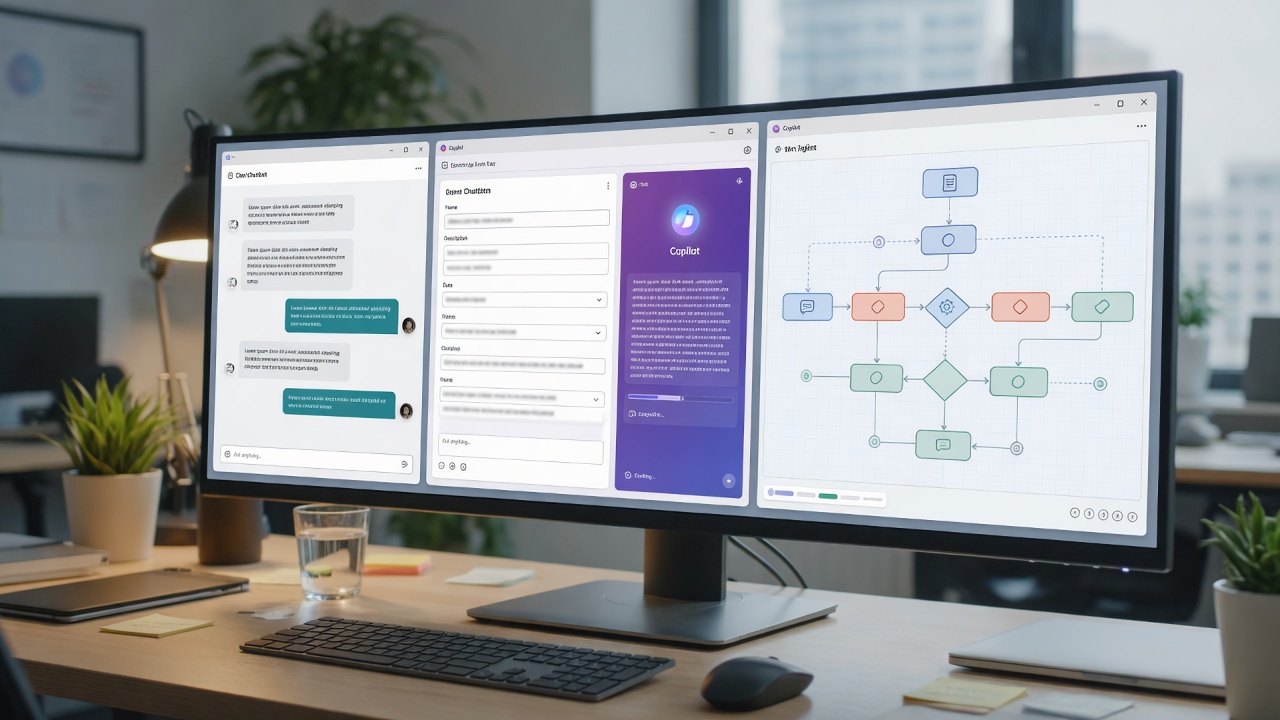
A copilot's job is to help a person who is already doing the work. It drafts inside the ticket. It suggests next fields. It summarizes the case while the agent (human agent, in the call-centre sense) stays in control. The human still clicks submit.
When a copilot wins:
Risk profile: medium. Bad suggestions can still be accepted by a hurried user. Shadow IT prompts and ungoverned copy-paste of client data show up often. Mitigations include putting the copilot in the approved system, limiting which data it can see, showing sources when possible, and training people that suggestions are drafts, not orders.
From a BA perspective, copilots map cleanly onto existing processes. You already know the swimlane. You are inserting a helper into steps that humans still own. That is often the best first production win for regulated or process-heavy teams.
An agent's job is to pursue a goal across steps and tools: plan, act, check, continue. It may open systems, assemble artifacts, and only stop when the work looks complete or a gate fires. That is closer to what agentic AI actually is than a single chat reply.
When a multi-step agent may be worth the complexity:
Risk profile: higher. Agents can take wrong paths at speed, call the wrong tool, or act on stale data. The blast radius grows with write access. Mitigations look like delivery discipline: least privilege, approval gates, step limits, evaluation sets, and a clear human owner. Tool design and protocols such as MCP matter because the integration layer is often where reliability is won or lost.
I use a crude table in workshops. It is not perfect, but it forces a choice.
Notice that "more autonomous" is not "more valuable." A well-scoped chatbot that deflects a real share of Tier-1 questions can beat a half-built agent that nobody trusts to touch production systems.
Pick one painful, recurring work product. Write down the finished artifact. Then ask:
If the answer is "all three," you still start with the smallest job that moves a metric. Many programs stack them later: RAG-backed chatbot for public questions, copilot for case handlers, agent for overnight assembly of internal packs.
The practical takeaway: name the job before you name the architecture. Chatbots, copilots, and agents carry different costs and different failure modes. Sponsors who choose the job first tend to fund pilots that can actually graduate. Sponsors who buy "an agent" because the demo was impressive often fund complexity they did not need yet.
I help sponsors and delivery teams match AI patterns to real jobs: chatbot, copilot, or agent, with a risk profile that leadership can stand behind.
Reach out for a quick chat on how I can help at Suganth@AruviConsultancyServices.com