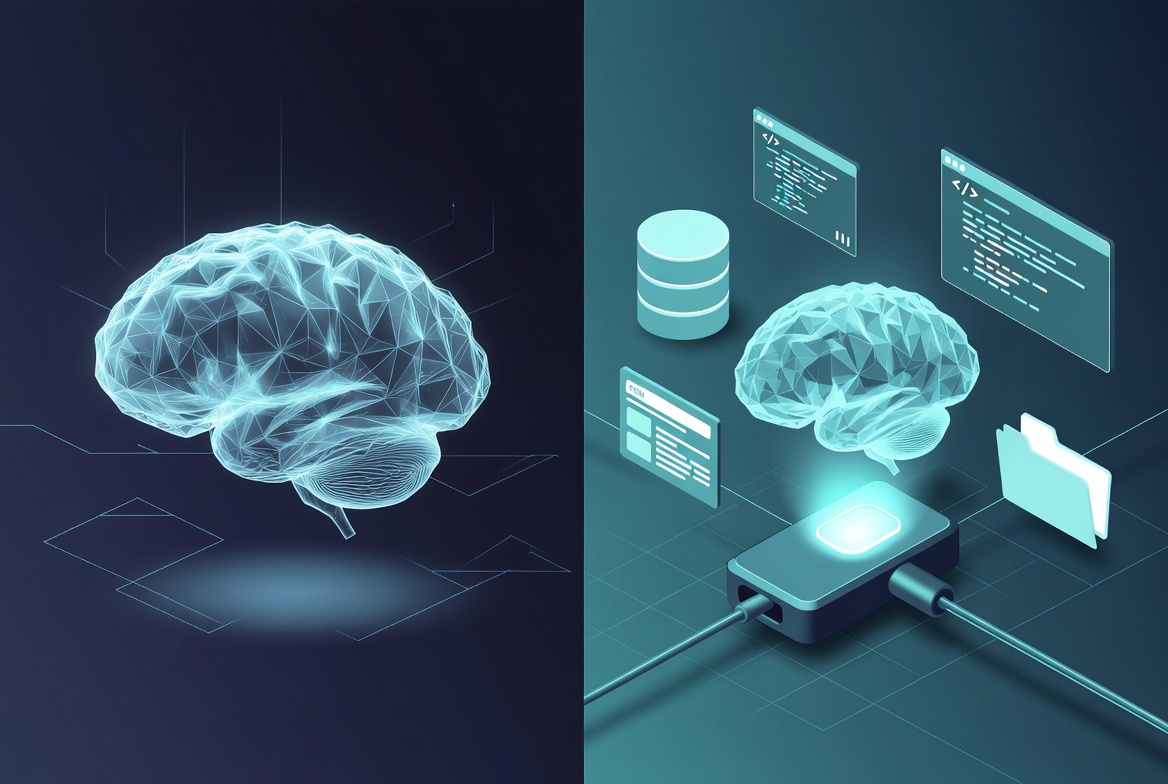
Most people still talk about “AI” as if it were one product. Open ChatGPT, ask a question, get an answer. Or drop an API key into an app and call the feature done. That mental model was fine when the main jobs were drafting, summarizing, and brainstorming. It starts to break when you want agents that work with real company systems.
Under the weekly model releases, something quieter is going on. Smarter models still matter, of course. More builders and enterprises are also asking: how does this model connect to the real world without a pile of one-off integrations? That is the MCP conversation. “MCP vs AI” is not really about a winner. It is about two different layers of the stack.
MCP stands for Model Context Protocol. Anthropic introduced it as an open standard in late 2024. The idea is simple: give AI systems a common way to talk to tools, data sources, and applications. Not a new model. Not another chatbot. A protocol. Closer to USB-C for LLMs than to a smarter brain.
In practice, an MCP server exposes tools, resources, and prompts in a consistent format. An MCP client inside a host such as Claude, ChatGPT, Cursor, Visual Studio Code, or another agent runtime can discover those tools at runtime and pick what fits the user’s task. The model does not need a custom integration for every service. It needs to speak MCP.
Sounds technical. The business angle is plain. If your CRM, document store, ticketing system, or internal database can sit behind a standard interface, you spend less time rewriting the same connector every time a new model or product shows up.
The distinction that helps in client conversations looks like this:
For a long time we treated the model as the whole product. Better model meant better results. That still counts. GPT‑5.6 Sol, for example, is a real step up for long-running professional work, coding agents, and knowledge workflows. You can still own a frontier model and get stuck if every new tool needs a custom function-calling schema, a new plugin, and a week of glue code.
How well the model can act in real systems is increasingly the ceiling, not only how well it talks about them. MCP is one of the clearer industry bets on reducing that friction.
If you are building products, internal agents, or AI-enabled operating models, the difference shows up quickly:
This is past the “interesting Anthropic experiment” stage. MCP shows up across major products including ChatGPT, Cursor, Gemini, Microsoft Copilot, and Visual Studio Code. Anthropic later donated the protocol to the Agentic AI Foundation under the Linux Foundation, which suggests the industry wants this layer open rather than locked to one vendor. By late 2025 there were already more than 10,000 active public MCP servers, from developer tools to enterprise deployments.
Imagine a mid-sized professional services firm. Analysts live in SharePoint and Google Drive. Project managers live in Jira or Azure DevOps. Client updates go out through email and PowerPoint. Leadership wants “AI that helps with delivery,” so the team tries a chat interface and a few custom API hooks.
Demos look fine. Production is harder. Every new system is another integration. Every model change risks breaking something. Permissions are inconsistent. Nobody is sure which connector is safe for client data.
Reframe the problem. Instead of only asking “which model should we buy?”, ask “how do we expose the systems people already use in a controlled, reusable way?” An MCP-style approach lets you stand up connectors for documents, tickets, and approved knowledge bases once, then let multiple agent hosts use them. Grounding those assistants in the company’s own material often means pairing tool access with RAG so answers stay specific to real policies and files. The model still matters (GPT‑5.6 Sol or Claude may draft the client update, summarize risks, or assemble a status pack), but the harness around the model is what makes the work reliable enough for delivery teams.
Coding tools make the same point in miniature. Cursor, Claude Code, Codex, and similar agents are useful not only because the model is smart, but because they can reach into the repository, run checks, and produce finished changes. The protocol and tool layer is what turns “smart chat” into “work done.”
Next time someone says “we are adding AI,” try a quieter question: are we bolting a model onto a chat interface, or building something that can reach the tools people already use?
That question changes the project plan. You stop optimizing only for demos and start designing for:
The model still matters. It is no longer the only lever. How context is gathered, how tools are exposed, and how actions are authorized are becoming just as important.
MCP is one signal that the industry is shifting from “talk to the AI” toward “let the AI work with the systems we already have.” Models will keep getting better. For leaders and delivery teams, the more interesting question is whether the rest of the stack keeps up: standards, connectors, permissions, and operating models that turn intelligence into useful action.
If you treat AI only as a model purchase, you keep buying brains. If you treat it as model plus protocol plus governed access to real work systems, you may build capability that lasts longer than the next release cycle.
I help organizations move from AI experiments to systems that connect to how work actually gets done. That often includes:
If you suspect your roadmap is heavy on the model and light on the harness around it, we can start with one concrete process and map the gap.
Reach out for a quick chat on how I can help at Suganth@AruviConsultancyServices.com