Bad RCA sessions have a smell. Someone already knows who to blame. The "why" chain stops at a person. The write-up is polished by Friday and nobody believes it. The same incident class returns next month with a different ticket number.
AI can make that worse if you use it as an automated judge. It can also make RCA better if you use it as a question generator and a completeness checker. The difference is facilitation. People who live the process still own the conclusion. The model helps them see angles they might skip when they are tired or defensive.
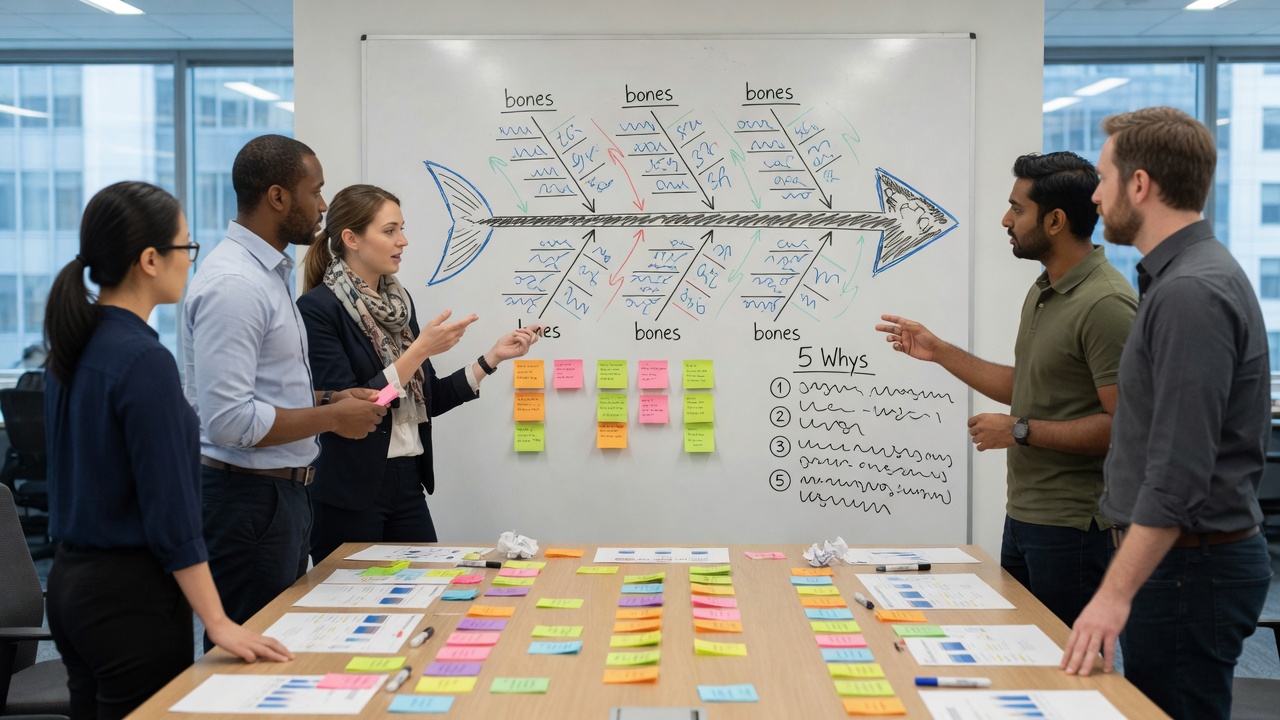
5 Whys is a simple chain: state the problem, ask why it happened, then why that, and so on, until you reach causes you can act on. Five is a guide, not a law. You may need three or eight. You often need branches, not a single ladder, because real failures have more than one contributing cause.
A fishbone (Ishikawa) diagram organizes candidate causes into categories around a problem statement: people, process, technology, materials, environment, measurement, and similar buckets. It is a structured brainstorm, not proof. Proof still needs evidence.
After you write a tight problem statement (what failed, when, impact, scope), I ask a model to:
That packet is a workshop starter, not a verdict. In the room, we kill weak branches quickly. We keep the ones that survive contact with logs, tickets, and the people who were there.
Instant root causes. Models like tidy endings. "Insufficient training" and "human error" appear early because those phrases are common. Sometimes training is part of it. Often the procedure is unclear, the UI is hostile, the roster is thin, or two systems disagree about status. If the first answer is a person, keep digging.
Confident tone without evidence. Fluent prose is not a timeline. Demand timestamps, ticket IDs, config changes, and who approved what. If the draft RCA cannot point to artifacts, it is still a hypothesis.
Skipping the system view. A single bad click can be the last event in a chain of bad defaults, missing alerts, and process design that made the error likely. Good RCA aims upstream enough that the fix is not "try harder next time."
I often run this with a lightweight tool so the structure does not live only in chat. The free RCA tool on this site covers problem framing, Pareto-style thinking, fishbone, 5 Whys, and a report path. Pair findings with a process fix map in Process Map Studio when the cause is a broken flow, not a one-off glitch.
One of the better uses of a model is to list what you do not know. "We do not have logs for step X." "We never defined what 'complete' means for handoff Y." Those gaps are findings. Closing a measurement gap can be a countermeasure all by itself.
If every cause is fully "known" in a one-hour meeting with no data pull, be suspicious. Speed is good. Certainty on thin ice is not.
If leaders punish honest timelines, people will feed the model a safer story and the output will look professional while being useless. Psychological safety is not soft decoration here. It is a data quality issue. Facilitators have to protect the room enough that causes can be named without a career event.
AI does not create that culture. It can, at best, offer neutral phrasing and a wider set of questions. The facilitator still steers away from scapegoats and toward controls, design, and process.
Use AI to expand the question set, stress-test completeness, and draft structure. Do not use it to crown a villain in the first paragraph. Keep 5 Whys branched and evidence-linked. Keep fishbones as candidate maps. Keep ownership with the people who can change the work.
Better questions, better evidence, better fixes. That is the bar. Instant blame was never root cause analysis. A fluent model should not make it fashionable again.
I facilitate root cause work that stays fair to the people involved and useful for the process. AI can support the questions; the team still owns the answers. That often includes:
Reach out for a quick chat on how I can help at Suganth@AruviConsultancyServices.com