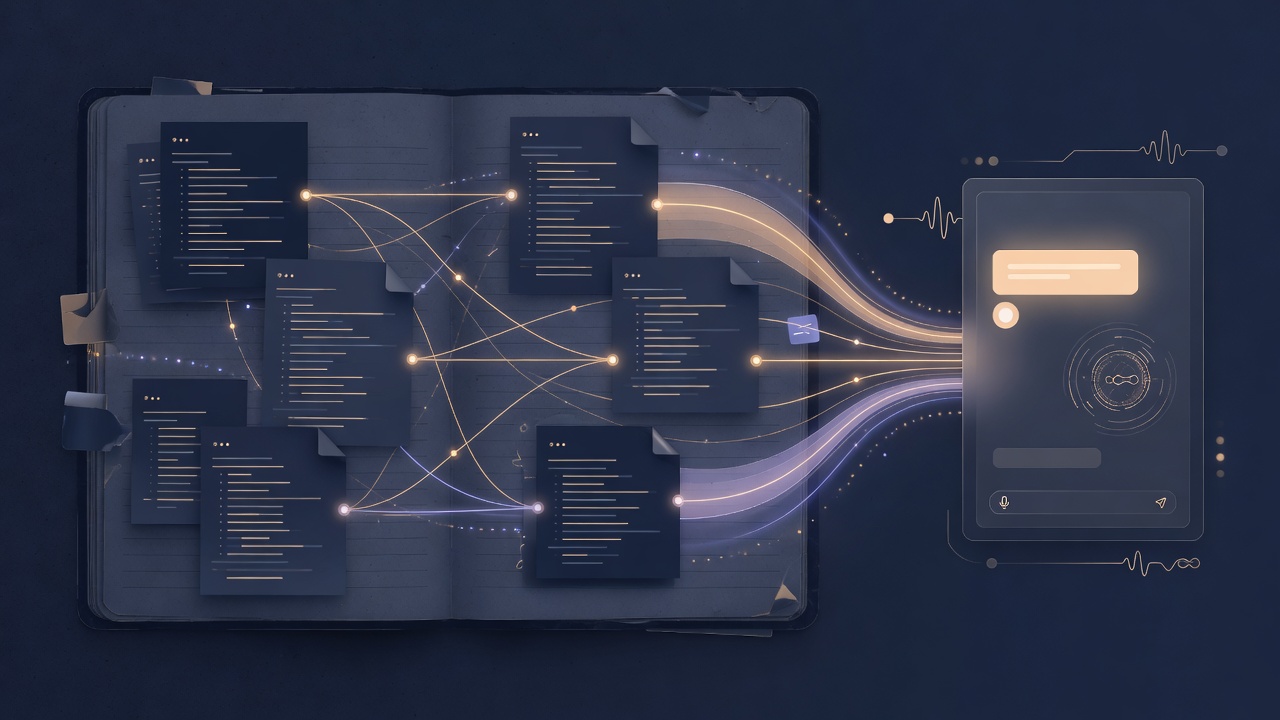
I keep running into the same gap. The model is smart enough for a useful answer. Then the next session starts blank. Project context, decisions, client notes, half-finished preferences: gone, or trapped in some chat history you will never reopen cleanly.
That is not only a “memory feature” problem. It is a knowledge problem. And one of the quieter tools that can help is something a lot of people already use for personal notes: Obsidian.
I am not saying every company should throw out Confluence and Notion tomorrow. I am saying Obsidian works surprisingly well for corporate knowledge work, for RAG, and for durable memory around an LLM, with some practical limits you should not ignore.
Obsidian is free for commercial and work use. The paid Commercial license became optional in early 2025. It is more of a way for organizations to support development now. It is already used inside more than 10,000 organizations, including large firms in finance, government, cybersecurity, healthcare, and tech. Amazon alone has had thousands of internal users. That is not a hobby app story anymore.
The strengths that matter in a corporate setting are pretty plain:
I like that last point more than I expected. The vault becomes a place where thinking is written down in a form both humans and machines can read.
Here is the honest part. Obsidian is not a full multi-user enterprise platform like Confluence, Notion Enterprise, or SharePoint. Live simultaneous editing of the same note is limited. Official Obsidian Sync supports shared vaults with end-to-end encryption, but it is roughly capped around 20 collaborators per vault and it is a paid add-on.
Large organizations usually treat it as a personal or small-team knowledge layer (per employee, or per project team), not as the one company-wide wiki. Many combine it with Git and internal tools, or they feed selected content into broader systems later.
Common patterns I have seen described and used:
If someone sells you Obsidian as “replace SharePoint for 5,000 people tomorrow,” be skeptical. If they sell it as a high-quality thinking and capture layer, that is closer to how it actually lands.
This is where it gets interesting for AI work.
Because everything is plain Markdown (often with YAML frontmatter, tags, and wikilinks), it is straightforward to index a vault, or specific folders, for retrieval. You can run local embeddings with tools like Ollama, or push into an enterprise vector database. Hybrid search becomes natural: keyword plus semantic plus following the graph of links.
Then you retrieve relevant notes or chunks and inject them into the LLM prompt. Grounded answers. Less guessing. The same idea I wrote about for company-specific AI, just with a vault that is already structured for thinking rather than a flat dump of PDFs.
There are ready-made local solutions (plugins and open-source tools) and custom pipelines with LangChain, LlamaIndex, DuckDB, Chroma, LanceDB, and similar. Keep everything local if privacy demands it. Or clean and index a subset into a private corporate vector store. The graph and linking structure often helps retrieval quality compared with a pile of disconnected documents. Links are a signal. Tags are a signal. Structure is not decoration here.
This might be the strongest use case, and it pairs naturally with RAG.
You structure the vault with dedicated areas for long-term knowledge: user or team profiles, project context, decisions, preferences, people notes, SOPs. Agents then do two things:
What you get is durable, human-readable, editable memory. It survives across sessions, models, and tools. If the chat product changes next quarter, the files are still yours. In a corporate setting the same vault can serve individual knowledge workers and shared team memory, with access controls and Git history doing some of the governance work.
I care about that more than I care about any single “memory” product feature. Product memory can be opaque. A Markdown note is something a person can open, disagree with, and fix.
If I were advising a corporation that wanted to try this without boiling the ocean, the path would look roughly like this:
This approach is especially attractive in regulated or privacy-sensitive environments (banking, law, professional services) because the core data stays under your control as plain files. That lines up with the same discipline behind keeping data ownership in your hands.
None of this is magic. Someone still has to write good notes. Someone still has to decide what is authoritative. The vault can become a mess if nobody owns it. But when the writing habit is there, you have something both people and agents can use. That is rarer than it sounds.
Models will keep changing. Chat UIs will keep changing. What ages better is structured, owned knowledge that can be retrieved and updated.
Obsidian is one practical way to get there for individuals and small teams, and as a feeder for larger enterprise knowledge systems. Use it for RAG. Use it for agent memory. Do not pretend it is SharePoint for the whole company. Start small, keep the files local and versioned, and let the AI work against something real.
If your AI workflow keeps forgetting what you already decided last month, the fix may not be a smarter model. It may be a better place for the work to live.
I help organizations design practical AI workflows where knowledge, retrieval, and agent memory are not afterthoughts. That can include:
If you want a grounded assistant or team memory layer without shipping your notes into a black box, we can start with one vault or one process and prove the pattern.
Reach out for a quick chat on how I can help at Suganth@AruviConsultancyServices.com