I keep seeing mid-market teams jump straight to “which model?” or “which vendor demo looked coolest.” Then the pilot stalls. Not because the model was weak. Because nobody checked whether the data was reachable, the use case was real, or anyone owned the risk when something went wrong.
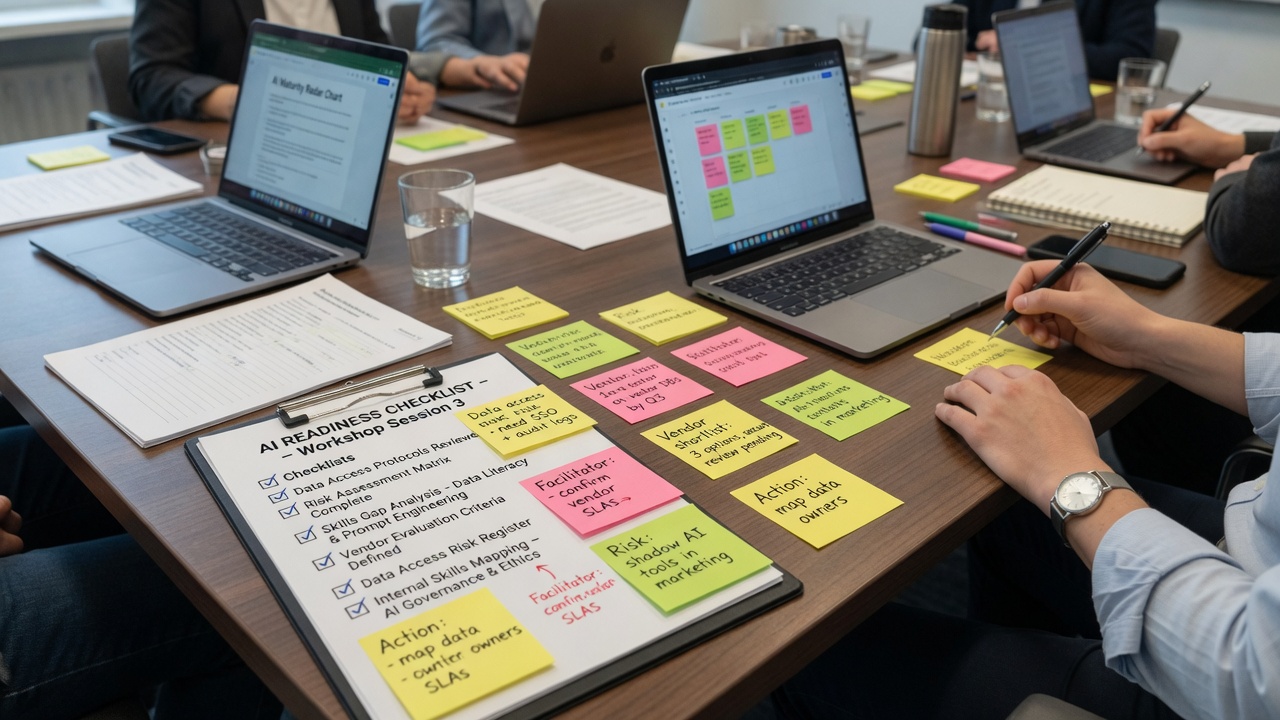
You do not need a six-month strategy program. You often need a half-day workshop with a blunt checklist. Something leaders can answer in plain language before money moves.
If people cannot get to the records the AI would need, you are shopping for a car without keys. Map where the relevant data lives: CRM, shared drives, tickets, ERP extracts, policy PDFs, spreadsheets someone still emails every Friday.
Ask concrete questions:
AI projects behave more like data projects than pure software builds. If that framing is new, this piece on data-first AI is worth a skim. Ownership matters too: who controls the data should be clear before a vendor embeds it in their stack.
“We should use AI” is not a use case. A use case names a user, a decision or task, the inputs, and what “done well enough” looks like. I like thin slices: one process step, one role, one measurable pain (time, rework, missed handoffs).
In the workshop, force each candidate through a few filters:
If you cannot explain the workflow, you probably cannot design the AI either. Process and requirements habits help here; BA-style framing is often underrated.
Risk does not have to mean a legal novel. It means answering: what happens if the system invents a fact, leaks a field, or sounds confident when it is wrong?
Cover at least:
Teams that skip this often discover the policy in production, which is the expensive way to write policy.
Mid-market groups rarely have a full AI lab. That is fine. You still need someone who can translate business need into tests, someone who can watch data quality, and someone who can say no when a demo is not ready.
Ask:
If the answer is “we will figure it out later,” budget later usually never arrives.
Vendors will show polished demos. Your job is to ask things demos skip:
If answers get vague on data residency, exit paths, or evaluation, treat that as a signal.
Ninety minutes to half a day is enough for a first pass:
Company-specific answers often need retrieval over your own material, not a generic chat box. When that is the case, RAG-style approaches should be on the table early, not as a surprise mid-build.
Practical takeaway: do not fund a pilot until you can name the use case, the data path, the review rule, the owner, and the exit criteria. The checklist is boring on purpose. Boring is what keeps mid-market AI from turning into an expensive demo.
I help mid-market teams run practical readiness work before they spend pilot budget. That often includes:
Reach out for a quick chat on how I can help at Suganth@AruviConsultancyServices.com